


By Kirsty Ludbrook
Placemaking for wellness destinations: the brand beyond the treatment room.
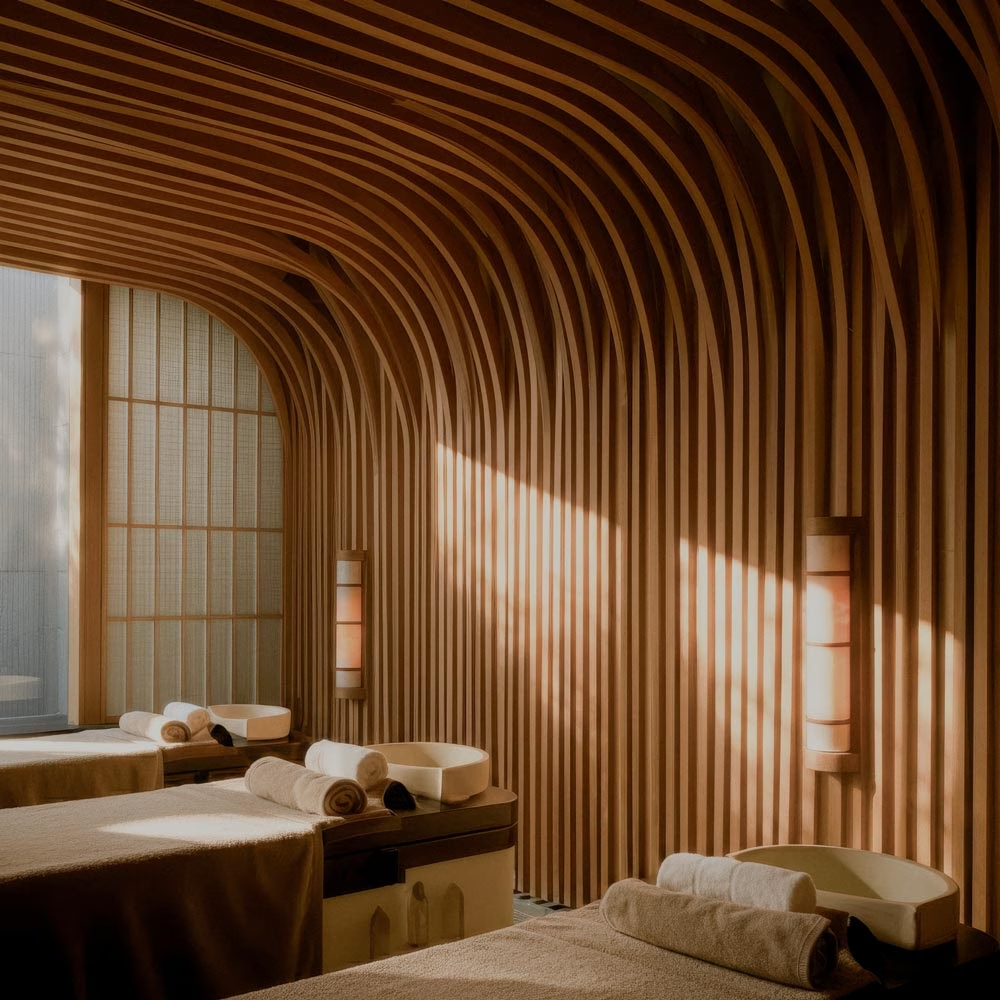
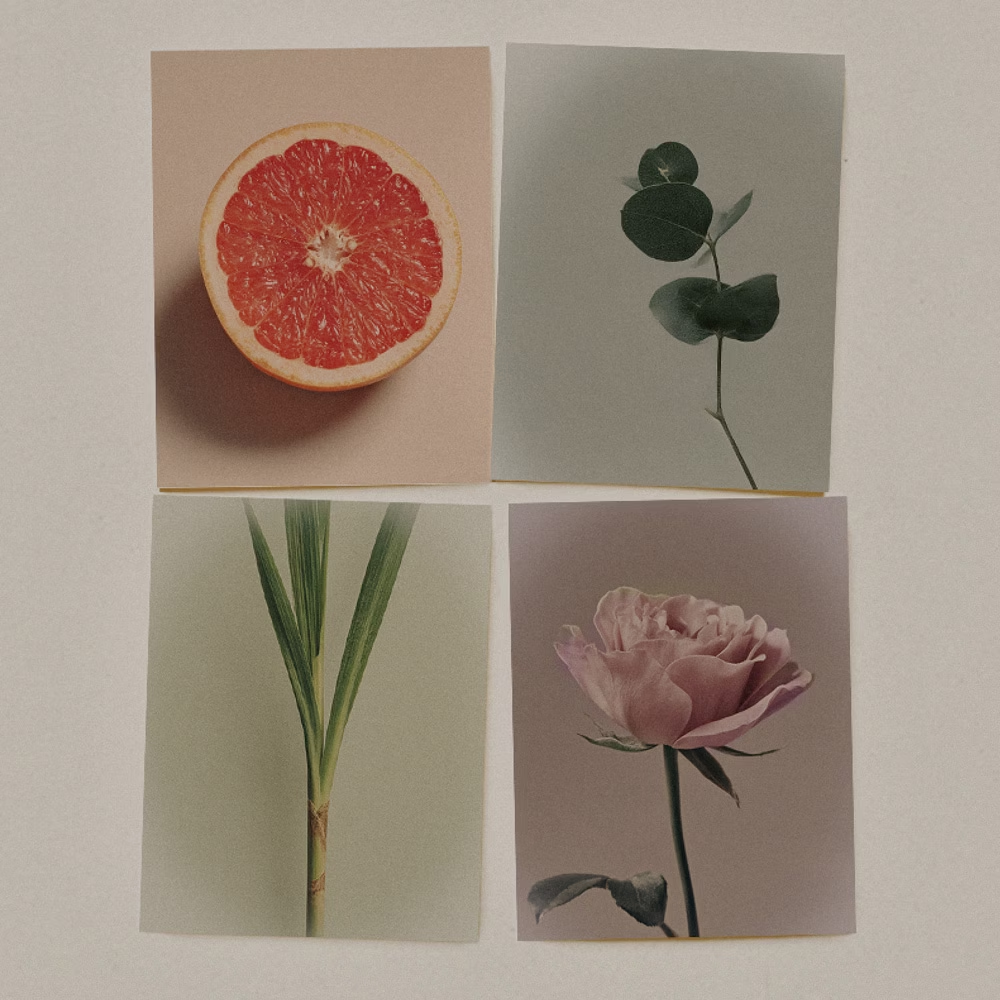
The wellness industry has a branding problem it rarely acknowledges. Spend an hour browsing the websites of luxury retreats, spa destinations, and wellness hotels, and a curious uniformity emerges: the same muted palette of sage and sand, the same fluid typography, the same photography of still water and folded linen. The aesthetics are beautiful. They are also, increasingly, indistinguishable.
This is not a superficial concern. In a sector where emotional resonance is the primary commercial driver — where guests choose one destination over another not on the basis of a price comparison but on the basis of how a place makes them feel before they have even arrived — brand distinction is not a marketing luxury. It is the business itself.
I have spent two decades working in health and wellness branding, and the challenge I return to most consistently is this: how do you create a wellness destination that is not just beautiful, but unmistakably itself? The answer lies in understanding that placemaking for wellness goes far beyond interior design and visual identity. It requires the brand to extend — coherently, deliberately, sensorially — into every dimension of the guest experience. Including the ones that have nothing to do with the treatment room.
Why wellness branding is different from hospitality branding
Every hospitality brand needs to make an emotional promise and deliver it through space. Wellness brands carry an additional obligation: they are promising transformation. Not just comfort, not just beauty, not just a pleasant few nights — but a meaningful shift in how a guest feels, functions, or understands themselves. That is a more intimate, more ambitious, and considerably more scrutinised promise than almost any other category makes.
The consequence is that inconsistency, which might be forgiven in a conventional hotel, becomes a specific kind of damage in a wellness context. If a retreat promises restoration and the brand experience is jarring, generic, or contradictory — if the signage feels corporate, or the in-room collateral looks like it was designed for a business hotel, or the digital experience is overwhelming rather than calm — the guest registers a dissonance between what was promised and what is being delivered. That dissonance undermines not just the brand but the experience itself.
Wellness placemaking, therefore, is held to a higher standard. It must be coherent not only visually but tonally, sensorially, and philosophically. The brand must feel like what it says it is — not just in the treatment room, but in every moment of encounter between the guest and the destination.
The Nine Senses of Branding: a framework for wellness placemaking
Several years ago I began developing a framework for understanding how brands connect with people at a deeper level than conventional branding theory accounts for. The result was Sensorial — a body of work and a published framework that extends the standard five physical senses into nine dimensions of brand experience.
The Nine Senses of Branding brings together the five physical senses — sight, sound, scent, touch, and taste — with four intuitive senses: Connection, Uniqueness, Harmony, and Integrity. The argument is that brands which operate across all nine dimensions build deeper trust, more lasting loyalty, and more enduring commercial value than those which operate through visual identity alone.
In no sector is this framework more directly applicable than wellness. A treatment room that engages sight, scent, sound, and touch simultaneously — and that does so in a way that feels coherent with the brand’s promise of Harmony and Connection — is delivering a multi-sensory brand experience, whether or not anyone has used those words in the brief. The question is whether that experience was designed, or whether it arrived by accident.
Designing it — which is to say, making deliberate decisions about every sensory dimension of the guest experience in service of a coherent brand idea — is what wellness placemaking at its best looks like. The physical senses are the medium. The intuitive senses are the message.
Building a sensory brand world: Karma Spa
Some of the most formative work of my practice in wellness branding was done not in Australia but in Bali, during the seven years Richard and I lived in Canggu between 2006 and 2013. It was there that we developed a long creative collaboration with Judy Chapman — one of the most respected spa consultants in Asia-Pacific — working alongside her on the spa programme for the Karma Group.
Following the success of the flagship spa at Karma Kandara, Karma Spa embarked on a rollout of luxury destination spas across Asia and Europe. Over a six-year engagement, our scope covered the full breadth of what sensory wellness branding demands: brand development, spa menu design, product and packaging design, signage and wayfinding, marketing collateral, photography, and individual spa websites for each location.
The brief for Karma Spa was one that sits at the heart of wellness placemaking: to create a brand world that could express the richness of the spa experience — part healing ritual, part luxury escape, part sensory journey. The visual and verbal identity needed to translate across multiple guest touchpoints and multiple geographies, rooted in Asian healing traditions but contemporary in its expression. It needed to feel complete: a world you entered, not a logo you encountered.
What the Karma Spa project taught me — in a way that shaped every wellness brief that followed — is that the ambition of a sensory brand world must be matched by the discipline of its execution across every touchpoint. A beautifully conceived brand identity that breaks down at the packaging level, or loses its character in the signage, or disappears entirely from the photography, is not a sensory brand world. It is a good start that was not followed through. The test is total consistency: does the brand feel the same in every encounter, in every location, in every object a guest holds?
Working with Judy Chapman on Karma Spa was also an early lesson in the value of the spa consultant–brand designer collaboration. Judy brought deep expertise in the experiential and therapeutic logic of a world-class spa; we brought the creative discipline to translate that expertise into a brand language. The result of that partnership — a brand that was both sensorially coherent and operationally grounded — is a model we have returned to many times since.
Position first, place second: the Mana Sanctuary model
The most instructive placemaking projects are those where brand strategy preceded every physical decision. Mana Sanctuary — a next-generation active recovery retreat in Bali — is one of the clearest examples of this discipline in our recent practice, and the one that most directly illustrates what wellness placemaking can achieve when it is approached as a complete, integrated act.
The project began not with a physical brief but with a strategic problem. The founders — who had built a successful women’s retreat brand, Escape Haven — wanted to create something new: a wellness destination that was inclusive, evidence-led, and genuinely distinct in a global retreat market crowded with aspirational aesthetics and vague promises of escape. The original working concept lacked the distinctiveness its ambitions demanded.
Following a two-day in-person brand workshop in Bali, we repositioned the retreat around a recovery-first philosophy: not escape, but rebuilding. Not aspiration, but evidence. Not another beautiful place to rest, but a sanctuary for restoring inner strength. The name Mana was chosen for its roots in Māori and Polynesian culture — where mana denotes a life force that is strengthened, not discovered, through integrity, respect, and connection. Sanctuary anchored the brand in protection and restoration.
What followed from that repositioning was a complete brand system designed to translate a philosophy into every dimension of the guest encounter: wordmark, visual language, retail, uniforms, wayfinding and signage, marketing collateral, and a website conceived as a calm, immersive digital experience that mirrors the retreat’s philosophy before a guest has stepped on a plane. A two-day location shoot in Bali — art directed to balance motion and stillness, intimacy and landscape — established an image library that carries a consistent brand signature across every channel.
What makes Mana instructive is the degree to which the brand strategy preceded and shaped the physical proposition. The spatial experience of the retreat is an expression of a brand idea, not the other way around. When that sequence is right, every subsequent design decision — material, spatial, graphic, digital — has a compass to navigate by.
The brand beyond the treatment room: what coherence actually requires
Most wellness destinations invest heavily in the quality of their treatments, their therapists, and their physical environments. Fewer invest with equal rigour in the brand coherence of what surrounds that core experience. Yet it is the surrounding experience — the moments before and after the treatment, the quality of every object that passes through a guest’s hands, the visual and sensory language of every space they inhabit — that determines whether the destination feels like a coherent world or a collection of good intentions.
The touchpoints that most commonly undermine wellness placemaking are the ones that receive least attention:
Arrival and wayfinding. The navigational language of a wellness destination sets a tone from the first moment of encounter. Signage that is corporate, cluttered, or tonally at odds with the retreat’s character creates an immediate dissonance. The best wellness wayfinding is calm, specific, and feels like an extension of the brand rather than an organisational overlay.
Amenity packaging. The objects in a guest’s room — body products, aromatherapy treatments, teas, supplements, sleep kits — are among the most intimately encountered brand expressions in any wellness property. They are held, opened, smelled, and read. Generic amenities in a premium wellness context send an unmistakable message about where the brand’s priorities end. On the Karma Spa project, bespoke product and packaging design was central to the scope precisely because these objects were understood as brand moments, not operational necessities.
Printed collateral. Treatment menus, welcome compendiums, programme schedules, and daily ritual guides are editorial opportunities. The language, typography, and material quality of these documents extend the brand’s tone of voice into the guest’s hands. A beautifully designed retreat with a treatment menu that reads like a corporate catalogue has a coherence problem.
The digital experience. For most guests, the brand encounter begins online, often weeks or months before arrival. Wellness website design carries an obligation that most other sectors do not: the digital experience must itself feel restorative, unhurried, and coherent with the philosophy the property is selling. A website that is busy, cluttered, or emotionally discordant with the physical retreat experience is not a neutral failure — it is actively undermining the promise the destination is making. In the Mana Sanctuary project, the website was designed as a direct translation of the retreat philosophy: calm, immersive, architecturally navigated, and paced for the reader.
Retail and take-home. The capacity for a wellness brand to extend beyond the destination — through retail product lines, lifestyle accessories, and branded merchandise — is both a commercial opportunity and a brand integrity test. What a guest takes home should carry the same character and philosophy as the space they are leaving. It is also the brand’s longest-lasting touchpoint.
Staff and uniform. The people who work within a wellness environment are themselves a brand expression. Uniform design that communicates the brand’s values — through material, silhouette, and the quality of finish — signals that the brand’s attention to detail extends to every human encounter, not only the spatial ones.
The distinction between wellness aesthetics and wellness identity
The saturation of the wellness aesthetic — sage, linen, raw timber, warm neutrals, organic form — is not the result of bad design. It is the result of good design being replicated so widely and so rapidly that the aesthetic has become a category convention rather than a brand distinction.
The difference between a wellness aesthetic and a wellness identity is the difference between looking the part and being it. An aesthetic can be adopted; an identity must be built. Identity is rooted in a specific point of view — a founder’s philosophy, a location’s character, a recovery model’s evidence base, a cultural heritage — and it expresses itself through every decision the brand makes, not just the ones that are visible on a mood board.
This is why the most commercially resilient wellness brands are those built around a clear, ownable idea. The aesthetics can evolve — they must, as the category continues to develop — but a brand rooted in a specific philosophy has a compass for every design decision, and a basis for genuine differentiation that trends cannot replicate.
The practical test is simple: if you removed the logo from every touchpoint in your destination, would a guest who knows your brand still recognise it? If the answer is yes, you have an identity. If the answer is uncertain, you have an aesthetic — and an aesthetic alone is a fragile foundation for a brand that is asking people to trust it with their health, their rest, and their most private moments of recuperation.
Building a wellness brand that lasts
The wellness sector is growing faster than almost any other category in global travel and lifestyle. New destinations are opening, new formats are emerging, and guest expectations — already high — are rising with every property that raises the standard. In this environment, the brands that will endure are not necessarily those with the largest budgets or the most spectacular architecture. They are those that are most precisely and completely themselves.
What that requires, from a brand perspective, is a willingness to invest in identity before aesthetics — to do the strategic work of defining what a destination genuinely stands for before making material decisions about how it looks. Wellness branding at this level is not a visual exercise; it is a strategic one, and it begins with the question of what the destination is actually for. It requires the discipline to extend that identity into every touchpoint, including the ones that seem peripheral. And it requires the understanding that placemaking in wellness is not a spatial discipline alone: it is a complete brand act, from the first digital encounter to the last object a guest packs into their bag.
The treatment room is where the core promise is delivered. But the brand experience begins long before the guest lies down on the table, and it continues long after they leave. The destinations that understand this — and design accordingly — are the ones that guests return to, speak about, and recommend with the conviction that comes from having experienced something that felt genuinely whole.
That is the brand beyond the treatment room. And in my experience, it is the most important room in the building.
VIEW MORE POSTS

By Kirsty Ludbrook
By Kirsty Ludbrook
By Richard Ludbrook
By Richard Ludbrook

By Richard Ludbrook
By Richard Ludbrook

By Richard Ludbrook

By Richard Ludbrook
By Kirsty Ludbrook

